
Identify: Asset Management & Mapping
IACS UR E26 Control 4.1: System Identification & Inventory
The foundation of vessel cyber security. You cannot protect what you cannot see. This playbook provides procedures for discovering OT assets and establishing the criticality matrix required for Class survey.
Why Identify comes first — on every vessel
You cannot protect what you have not mapped. This applies equally to a newbuild working toward IACS UR E26 certification and to an existing tanker fleet implementing IMO MSC-FAL.1 requirements ahead of a SIRE inspection. The starting point is always the same — a documented inventory of every networked system onboard, an honest assessment of what each system does and what the consequence of losing it would be, and a map of how systems connect to each other and to the outside world.
For vessels subject to IACS UR E26, the Identify phase produces the Cyber System Description Document (CSDD) — the primary document Class surveyors review. For existing vessels, the same work produces the risk register and asset inventory required by IMO MSC-FAL.1/Circ.3 Rev.3, TMSA 3 Element 13, and the Industry Guidelines on Cyber Security Onboard Ships. The documents are different in format but the underlying work is identical — understand what is on the vessel, how critical each system is, and where the boundaries between zones sit.
Getting this phase right also has a practical operational benefit beyond compliance. An ETO who has mapped every CBS, knows which systems share network segments, and understands which protocols are in use is in a fundamentally stronger position during an incident — because they already know the topology rather than discovering it under pressure.
A compliant Asset Inventory is more than a list of IP addresses. It must define the Logical Connectivity between navigation, propulsion, and administrative systems. This blueprint visualizes how data flows across the vessel’s digital topography.
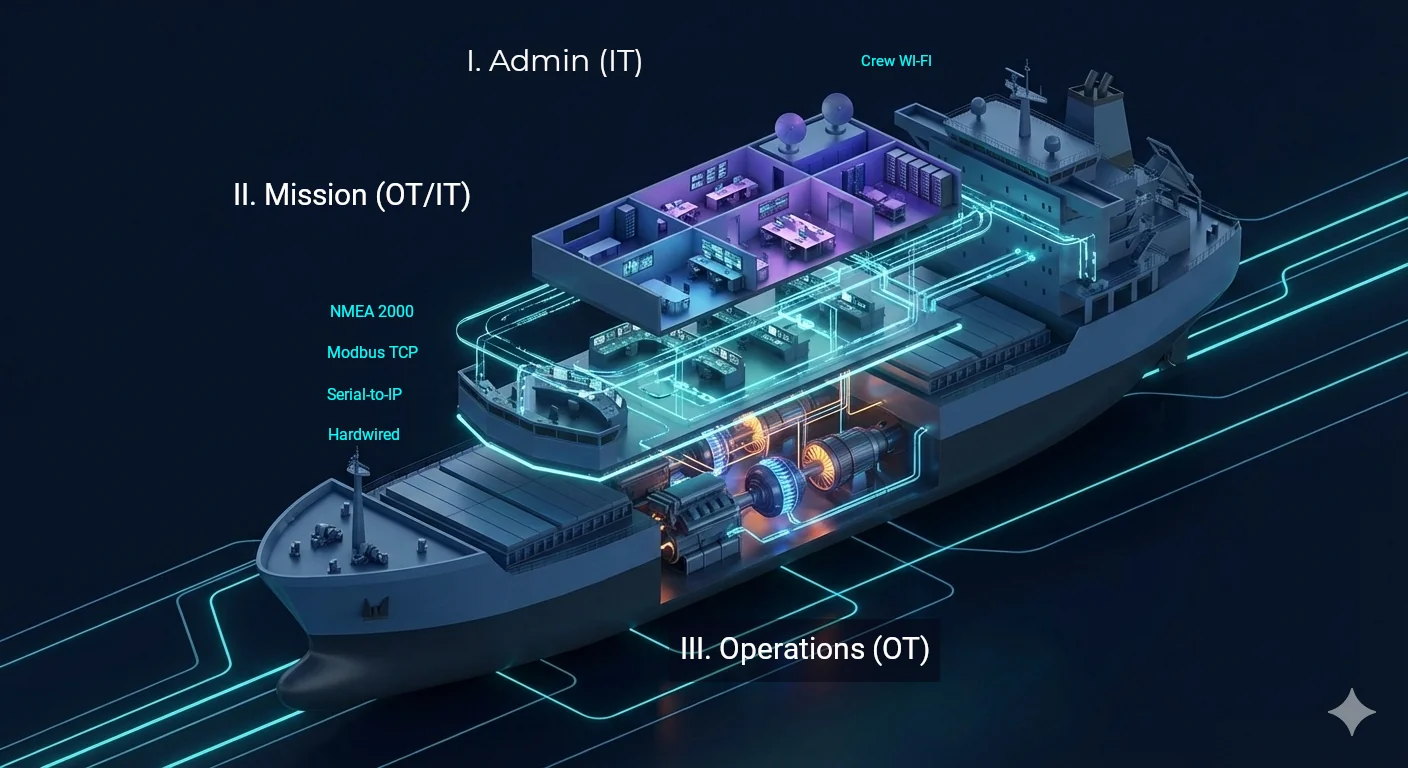
Reference: Tagsia Asset Discovery Standard (IACS UR E26 / NIST Aligned)
Asset Management
Requirement 4.1.1: Full inventory of hardware, software, and firmware. Categorize systems (I, II, or III).
Communication Mapping
Document information flows, marine protocols, and critical system interdependencies across the vessel.
Governance
Finalizing audit readiness. Establishing roles, Management of Change (MoC) policies, and CSDD reports.