
Identify: Asset Management & Mapping
IACS UR E26 Control 4.1: System Identification & Inventory
The foundation of vessel cyber security. You cannot protect what you cannot see. This playbook provides procedures for discovering OT assets and establishing the criticality matrix required for Class survey.
A compliant Asset Inventory is more than a list of IP addresses. It must define the Logical Connectivity between navigation, propulsion, and administrative systems. This blueprint visualizes how data flows across the vessel’s digital topography.
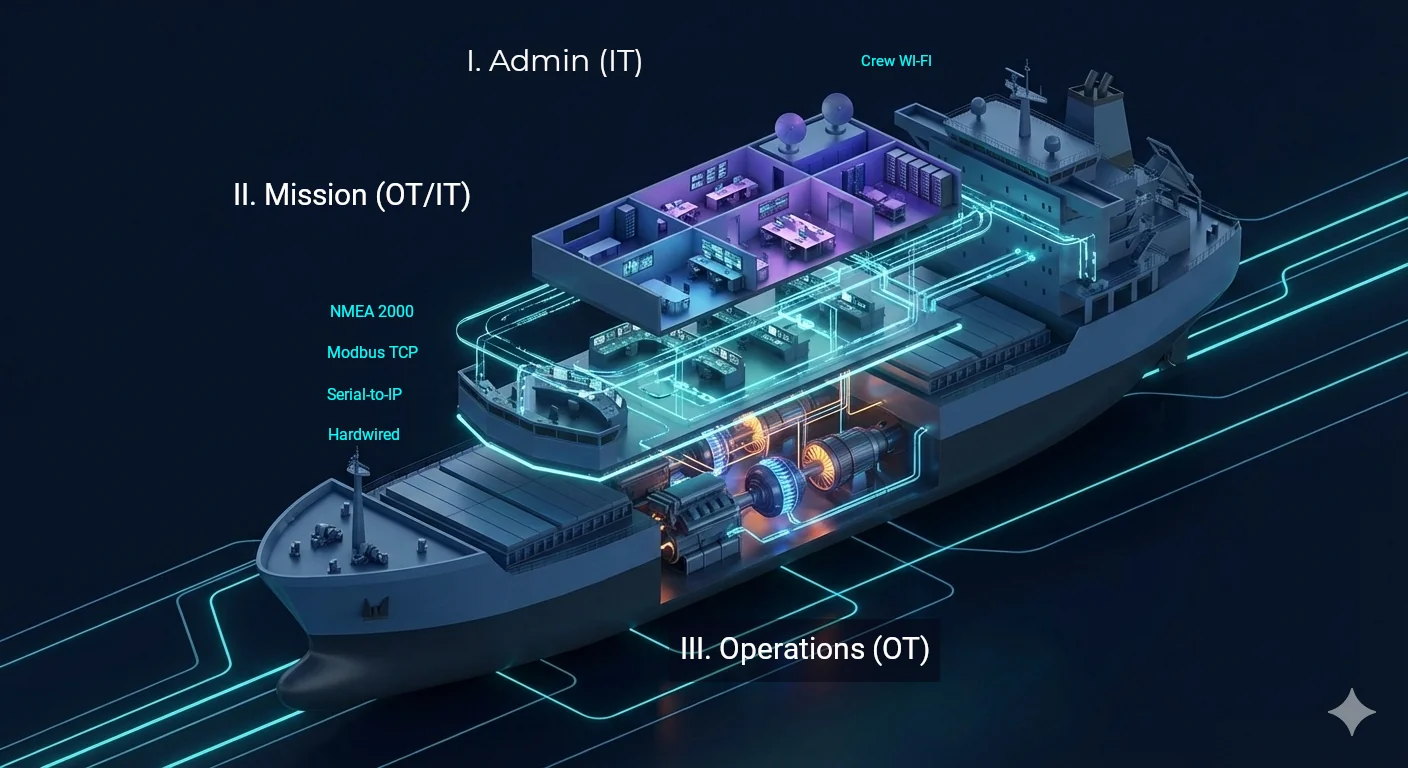
Reference: Tagsia Asset Discovery Standard (IACS UR E26 / NIST Aligned)
Asset Management
Requirement 4.1.1: Full inventory of hardware, software, and firmware. Categorize systems (I, II, or III).
Communication Mapping
Document information flows, marine protocols, and critical system interdependencies across the vessel.
Governance
Finalizing audit readiness. Establishing roles, Management of Change (MoC) policies, and CSDD reports.
