
CBS Safe State & Fallback to Minimal Risk Condition
This guide defines what each critical CBS must do when it loses power, network connectivity, or operational integrity — and how the vessel is brought to a documented Minimal Risk Condition when normal recovery is not possible.
IACS UR E26 §4.4.4 requires that every Computer Based System in scope has a pre-defined safe state — a known, documented condition the system defaults to when it fails or is deliberately isolated. This is not the same as switching to local manual operation (§4.4.2) or executing an emergency shutdown (§4.4.1). A safe state is what the system does by itself when it loses control input or network integrity, before any human intervention takes place.
If a CBS does not have a defined safe state, a cyber-induced failure could leave it in an unknown or dangerous condition — a propulsion system holding full ahead, a fire detection system going silent, or a steering system freezing on its last heading. The Class Surveyor will ask: “What does this system do when it fails? Is that documented?”
Safe State vs Minimal Risk Condition — The Distinction
CBS Safe State
The pre-programmed condition a single CBS falls into automatically when it loses power, loses network connection, or detects an integrity fault. Defined per system. Documented in the CSDD. Requires no human action — it is a hardware or firmware-level behaviour. Example: a fire detection panel that defaults to alarm-active when its network link is severed.
Minimal Risk Condition (MRC)
The vessel-level condition achieved when multiple CBS have failed or been isolated and normal operations cannot be safely continued. The MRC is the endpoint of the incident response — the point at which the vessel is as safe as possible given the circumstances, and the crew can hold position or proceed to port under manual control. Requires documented procedures and Master authorisation.
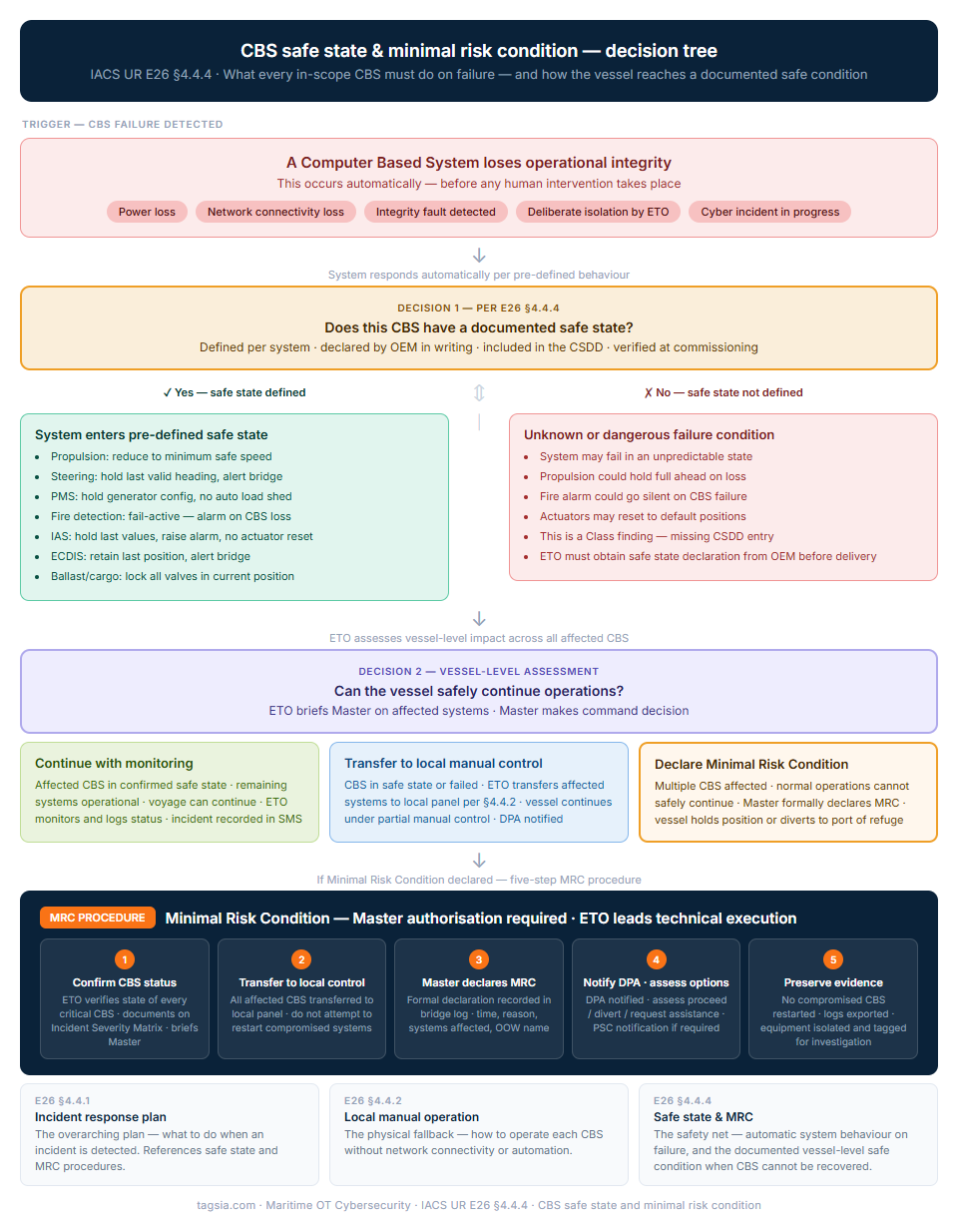
The decision tree shows the two-stage assessment an ETO must work through when a CBS loses integrity. The first stage is per-system — does this CBS have a defined safe state, and is it entering that state correctly? The second stage is vessel-level — given the current operational picture, can the vessel continue safely or does the Master need to declare a Minimal Risk Condition?
The most important distinction in E26 §4.4.4 is that a safe state is an automatic system-level response, while the MRC is a command-level decision. An ETO cannot declare an MRC — only the Master can. But the ETO is responsible for giving the Master an accurate picture of which systems are affected, what state they are in, and what the manual fallback options are.
The five-step MRC procedure at the bottom of the diagram is what every ETO should be able to execute from memory during a real incident.
<< Click the diagram to expand at full resolution
Safe State Requirements — System by System
The following table defines the required safe state behaviour for each Category III system. These must be verified at commissioning, documented in the CSDD, and referenced in the Incident Response Plan. The ETO is responsible for confirming the safe state behaviour with each OEM before delivery.
Reaching Minimal Risk Condition — The Procedure
When individual CBS safe states have been triggered but the vessel cannot safely continue normal operations, the Master authorises a transition to MRC. This is the vessel-level endpoint of a serious cyber incident. The ETO leads the technical execution; the Master retains command authority throughout.
Common Gaps — What Surveyors Find
No safe state documentation from OEMs
The most common gap — the ETO assumes the system fails safely but has no written confirmation from the OEM. Safe state behaviour must be declared in writing and included in the CSDD.
MRC not defined in the IRP
The Incident Response Plan mentions containment and recovery but does not define what MRC looks like for this vessel specifically or who has authority to declare it. MRC must be a named procedure in the IRP.
Safe state not tested at commissioning
The OEM has declared a safe state in documentation but it has never been physically triggered to verify the behaviour matches the declaration. Class surveyors increasingly require evidence of a commissioning test, not just a vendor document.
Conflicting safe states between systems
Individual system safe states have been defined in isolation but create a conflict when triggered together — for example a PMS that sheds load to “safe state” while the IAS simultaneously tries to maintain process parameters that require that load. Safe states must be reviewed as a system, not individually.
The Link Between §4.4.2, §4.4.1, and §4.4.4
These three requirements work together as a single response framework. §4.4.1 (Incident Response) is the plan — what to do when an incident is detected. §4.4.2 (Local Manual Operation) is the physical fallback — how to operate systems without CBS. §4.4.4 (Safe State / MRC) is the safety net — what each system does automatically before the human response begins, and the documented vessel condition when CBS cannot be recovered. A Class Surveyor assessing E26 compliance will check all three together. If any one is missing, the others are incomplete.
Compliance Documentation
Templates supporting safe state declaration and MRC procedures.
The specific regulatory requirements this playbook satisfies. Use these references when preparing for Class survey or responding to a surveyor's checklist.